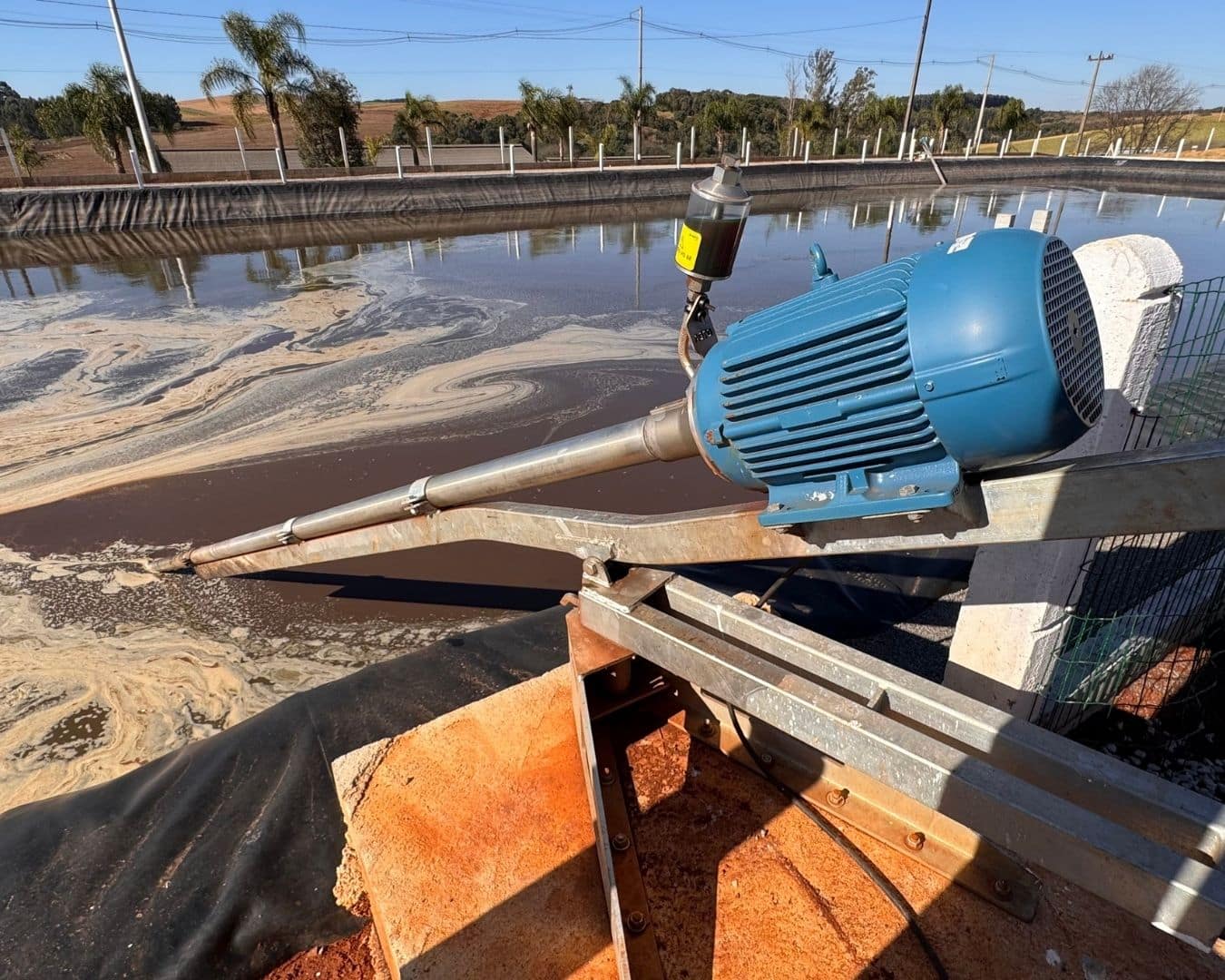
The shortage of labor in the agricultural sector is no longer an isolated incident but has become a reality for Brazilian dairy farming. Data from IBGE (Brazilian Institute of Geography and Statistics) and Embrapa (Brazilian Agricultural Research Corporation) show a continuous reduction in the population employed in rural activities, especially in operational roles. In this context, organizing waste management on farms with reduced staff has become a strategic necessity to ensure efficiency, continuity of production, and environmental safety.
Manure management is one of the most sensitive routines on a farm. When poorly organized, it consumes time, generates rework, and increases risks. On the other hand, when structured technically, it allows the farm to operate with fewer people, more control, and greater predictability.
The challenges of waste management with a reduced staff.
On farms with lean teams, any process flaw quickly becomes apparent. Waste management, requiring regularity and continuous attention, is usually one of the first areas to show problems.
Among the main challenges are:
-
Excessive dependence on specific individuals to perform critical tasks.
-
Lack of standardization in management routines
-
Difficulty maintaining adequate frequency of shaking and application.
-
Accumulation of tasks when the team prioritizes other activities.
-
Increased risk of operational failures during periods of higher demand.
In this scenario, the problem lies not only in the lack of manpower, but also in the lack of organization within the system.
Common mistakes when management is not organized.
When waste management doesn't follow a clear logic, certain mistakes tend to be repeated, especially on farms with few employees.
The most common ones are:
-
Operate the system only when a problem arises.
-
Not maintaining a fixed routine for homogenizing the lagoon.
-
Perform tasks differently for each operator.
-
Postponing essential activities due to lack of time.
-
Always work in emergency mode.
These errors don't stem from ill will, but from a lack of defined processes. Over time, they compromise the efficiency of fertigation, increase odors, and raise environmental risks.
How to standardize waste management with fewer people
Organizing waste management on farms with small teams requires, first and foremost, standardization. This means transforming operational tasks into clear and repeatable processes.
Several points are fundamental:
-
Establish fixed agitation and handling routines.
-
Reduce manual decision-making in daily life.
-
Establish clear technical parameters for operation.
-
Integrate the management steps into a single logical flow.
When the process is standardized, the system no longer depends on specific individuals and begins to function more stably, even with small teams.
The importance of predictability in waste management.
In labor-intensive properties, predictability is as important as efficiency. A predictable system allows for planning activities, avoiding team overload, and reducing errors.
In waste management, predictability means:
-
Lagoons always in suitable condition.
-
Less variation in nutrient concentration
-
More regular fertigation
-
Reduction of corrective interventions
Furthermore, predictable systems facilitate compliance with environmental legislation and reduce operational risks.
The role of automation in waste management.
Automation in waste management does not replace people, but it reduces direct dependence on manual labor for repetitive and critical tasks.
On farms with small staff, automation allows for:
-
Maintain the lagoon's homogeneous consistency continuously.
-
Standardize handling regardless of the operator.
-
Reduce the need for constant intervention.
-
Ensuring consistency even during periods of higher demand.
With this, the producer stops "putting out fires" and starts operating with more control and peace of mind.
Best practices for maintaining operational efficiency.
Even with a lean team, some best practices help maintain efficient management:
-
Properly sizing ponds and systems
-
Integrate agitation, separation, and application.
-
Monitor the system periodically.
-
Perform preventive maintenance on equipment.
-
Avoid reactive and emergency operations.
These practices reduce staff burnout and increase the lifespan of the system as a whole.
Organized management is also sustainability.
Well-organized waste management not only benefits the farm's daily operations, but also directly contributes to the property's environmental sustainability.
Among the main benefits are:
-
Odor reduction
-
Lower risk of overflow.
-
More uniform application to the soil.
-
Better nutrient absorption
-
Greater compliance with legal requirements.
Thus, organization and sustainability go hand in hand in waste management.
Conclusion
Organizing waste management on farms with small teams is not just a matter of operational efficiency, but of the survival of the production system. In a scenario of structural labor shortages, well-defined processes, predictability, and automation become strategic allies for the rural producer.
When management is structured technically, the farm operates with fewer people, less rework, and more control, transforming a cumbersome routine into a stable and safe process.
💬 Do you want to organize your farm's waste management even with a small team?
Speak with the AGTO technical team and request an analysis of your system. We will help you structure a more efficient, predictable management system aligned with the reality of your property.