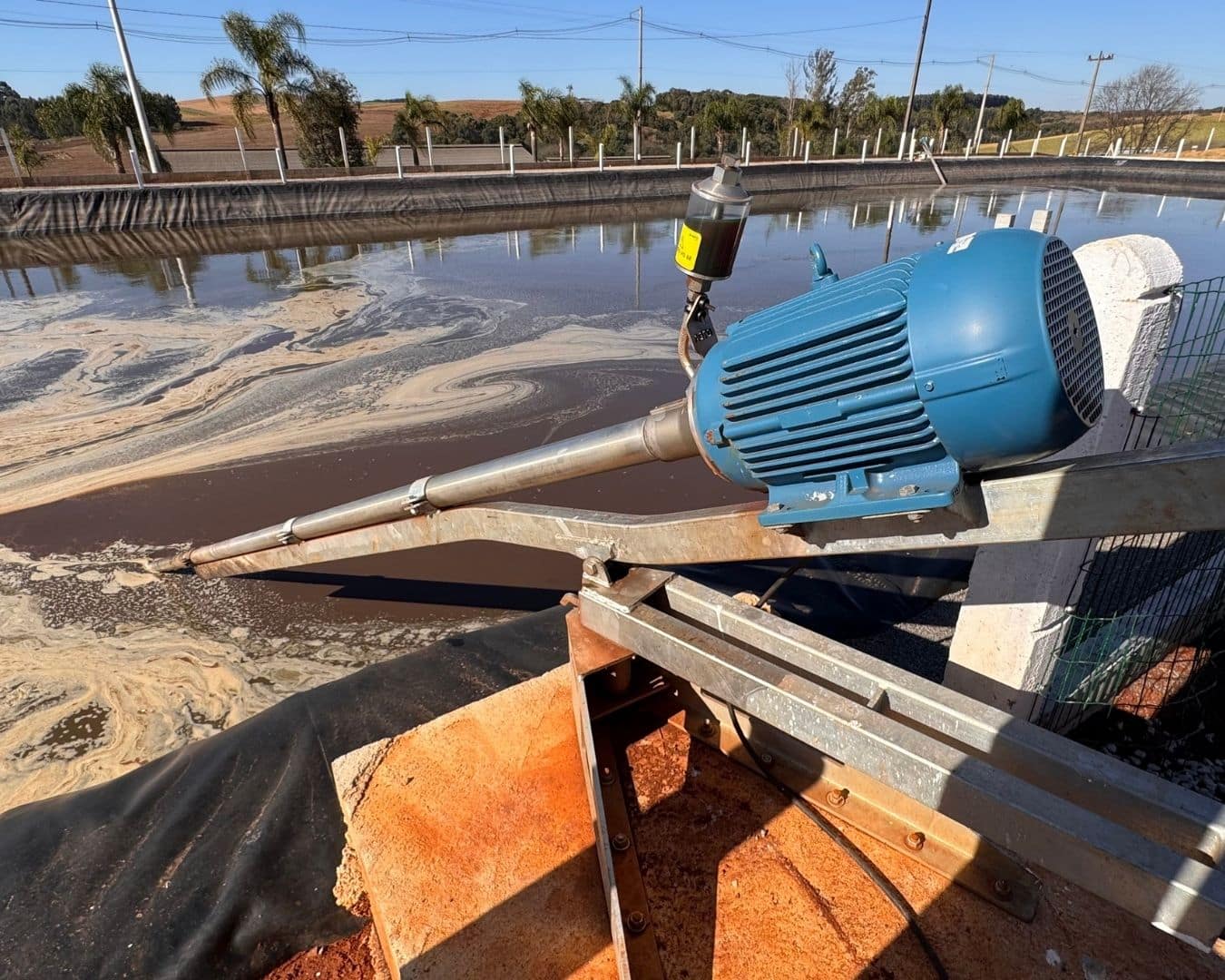
Fertigation is one of the main advantages of using manure in dairy farming. When properly managed, the residues are transformed into organic fertilizer, reducing costs with chemical fertilization and improving the productive efficiency of the farm. However, all this depends on one essential factor: proper homogenization of the waste lagoon.
Poorly homogenized lagoons are one of the most common causes of problems in fertigation. They compromise application to the soil, reduce nutrient uptake, and increase operational and environmental risks.
What does it mean to properly homogenize a waste lagoon?
Homogenizing a waste lagoon means keeping the entire stored volume in a... uniform motion, preventing excessive separation between solids and liquids.
In a well-homogenized lagoon:
-
The nutrients are distributed more evenly.
-
The material applied to the soil is more predictable.
-
The system operates with greater stability.
When this homogenization does not occur, the management ceases to be technical and becomes unstable.
What happens in poorly homogenized lagoons?
In the absence of efficient agitation, the waste tends to separate naturally. The heavier solids settle to the bottom, while the liquid portion remains concentrated on the surface.
This scenario creates a number of problems:
-
Formation of layers of solids at the bottom of the lagoon.
-
Reduction in usable storage volume
-
Variation in nutrient concentration
-
Increased odors
-
Pumping difficulties
Over time, the lagoon loses operational efficiency and begins to constantly operate at its limit.
Direct impacts on fertigation
Fertigation depends on regularity and predictabilityWhen the lagoon is not homogeneous, the producer faces recurring problems.
Irregular application of nutrients
Without homogenization, the concentration of nutrients varies over time. At times, the applied material is too diluted; at other times, it is excessively concentrated.
This results in:
-
Underdosing in some areas
-
Excess nutrients in other
-
Loss of agronomic efficiency
Blockages and system failures
The accumulation of solids increases the risk of:
-
Pump clogging
-
Pipe blockage
-
Failures in sprinklers and distributors
These problems lead to unexpected downtime and increase maintenance costs.
Waste of fertilizer potential
A large portion of the nutrients remains trapped at the bottom of the lagoon, without being utilized. The producer applies only the surface liquid fraction, wasting the agronomic value of the waste.
In practice, this means:
-
Lower return on management
-
Increased need for supplemental fertilization.
-
Lower efficiency of the system as a whole.
The relationship between homogenization and sustainability.
In addition to impacting production, poorly homogenized lagoons increase environmental risks.
Among the main problems are:
-
Irregular application to the soil
-
Increased risk of surface runoff.
-
Increased odors
-
Potential for overflow during rainy periods.
These factors make it difficult to comply with environmental legislation and expose the property to unnecessary risks.
The importance of continuous agitation in manure management.
For fertigation to work correctly, the lagoon needs to be homogeneous. before and during application.
Continuous agitation:
-
Keeps solids in suspension.
-
Ensures material uniformity.
-
It facilitates pumping.
-
Reduces operational errors.
Without an efficient agitation system, fertigation becomes unpredictable and risky.
How to avoid homogenization problems
Several points are crucial to avoid poorly homogenized lagoons:
-
Correct sizing of the lagoon
-
Proper agitation according to the volume and type of waste.
-
Routine maintenance management
-
Integration between agitation and fertigation
When these factors are addressed technically, the system operates more efficiently and safely.
Homogenization as the basis for efficient management.
In dairy farming, fertigation doesn't begin in the soil—it begins in the lagoon. A well-homogenized lagoon ensures:
-
Better nutrient absorption
-
Lower operational risk
-
Odor reduction
-
Greater agronomic efficiency
-
More environmental control
Without homogenization, any fertigation system tends to fail over time.
Conclusion
Poorly homogenized lagoons directly compromise fertigation, leading to waste, operational failures, and environmental risks. The problem lies not in the use of the waste, but in how it is managed before application.
Ensuring a homogeneous lagoon is a technical decision that impacts the entire production chain of a dairy farm.
💬 Do you want to improve the fertigation efficiency of your farm?
Speak with the AGTO technical team and discover how to structure your waste management with greater control, safety, and results.