Waste management is no longer just an operational issue on a farm. Today, it is also an environmental, legal, and strategic matter. Complying with environmental legislation regarding waste management is essential to avoid fines ranging from R$5,000 to R$50 million, injunctions, and problems with regulatory bodies, as well as ensuring the long-term sustainability of production.
For rural producers, the main difficulty lies not only in complying with the law, but in understanding what is actually required, since the legislation involves federal regulations (such as Law 12.305/2010 and CONAMA Resolution 430/2011), state and municipal regulations, as well as specific rules for each type of activity.
Why is waste management regulated by law?
Animal waste has a high pollution potential when not managed correctly. Soil, water, and air contamination can occur due to leaks, improper application, or incorrect storage.
For this reason, waste management is directly linked to environmental legislation aimed at:
- Protecting water resources
- Avoid soil contamination
- Reduce emissions and odors.
- To guarantee environmental and sanitary safety.
Producers who ignore these requirements assume environmental and legal risks that could compromise the entire operation.
Key legal requirements for waste management
Although the rules may vary depending on the state and type of production, there are common points that every rural producer needs to meet.
Environmental licensing of the activity
Animal farming, especially in intensive systems, requires environmental licensing from the relevant authorities (IBAMA, state agencies such as FEPAM, IAP, CETESB, among others). This licensing assesses:
- Waste generation capacity
- Storage method
- Treatment and final disposal
- Risk of environmental impact
Without a license or with an irregular license, the property is subject to fines and closures.
Proper storage of waste
Legislation requires that manure be stored safely, preventing leaks and overflows. Typical sizing considers a volume of 0.10 to 0.15 m³ per finished pig, for example.
The lagoons need:
- Having the right squad size for the team.
- To be waterproofed (with geomembrane or compacted clay)
- Maintaining structural stability
- Avoid excessive accumulation of solids.
Lack of homogenization is one of the factors that generates the most problems, as the accumulation of solids reduces the usable volume of the lagoon and increases environmental risk.
Correct application to the soil (fertigation)
The use of manure as fertilizer is permitted, but it cannot be done indiscriminately. Legislation requires:
- Application according to soil capacity and nutritional analysis.
- Respect for minimum distances from watercourses (according to the Forest Code – Law 12.651/2012): normally 30m for rivers less than 10m wide.
- Control the amount applied (avoiding overload of nitrogen and phosphorus)
- Material homogeneity
- Documentation of the application plan and fertigation records
When manure is not properly mixed or separated, fertigation becomes irregular, increasing the risk of environmental contamination.
Mandatory safety distances
In addition to waterways, it is necessary to respect distances of:
- Wells and springs: generally 50m or more
- Urban areas: as per municipal legislation
- Property boundaries: distances vary by state.
Required documentation
To be in compliance, the producer must maintain:
- Valid environmental license (LP, LI and LO when applicable)
- Technical project of the waste management system
- Maintenance records of equipment and structures
- Proof of destination when there is a transfer of material
- Soil and manure analyses updated
- Application plan of waste in the soil
How technology helps producers comply with legislation.
Complying with environmental legislation depends not only on paperwork. It depends, primarily, on process control.
This is where the right equipment makes all the difference.
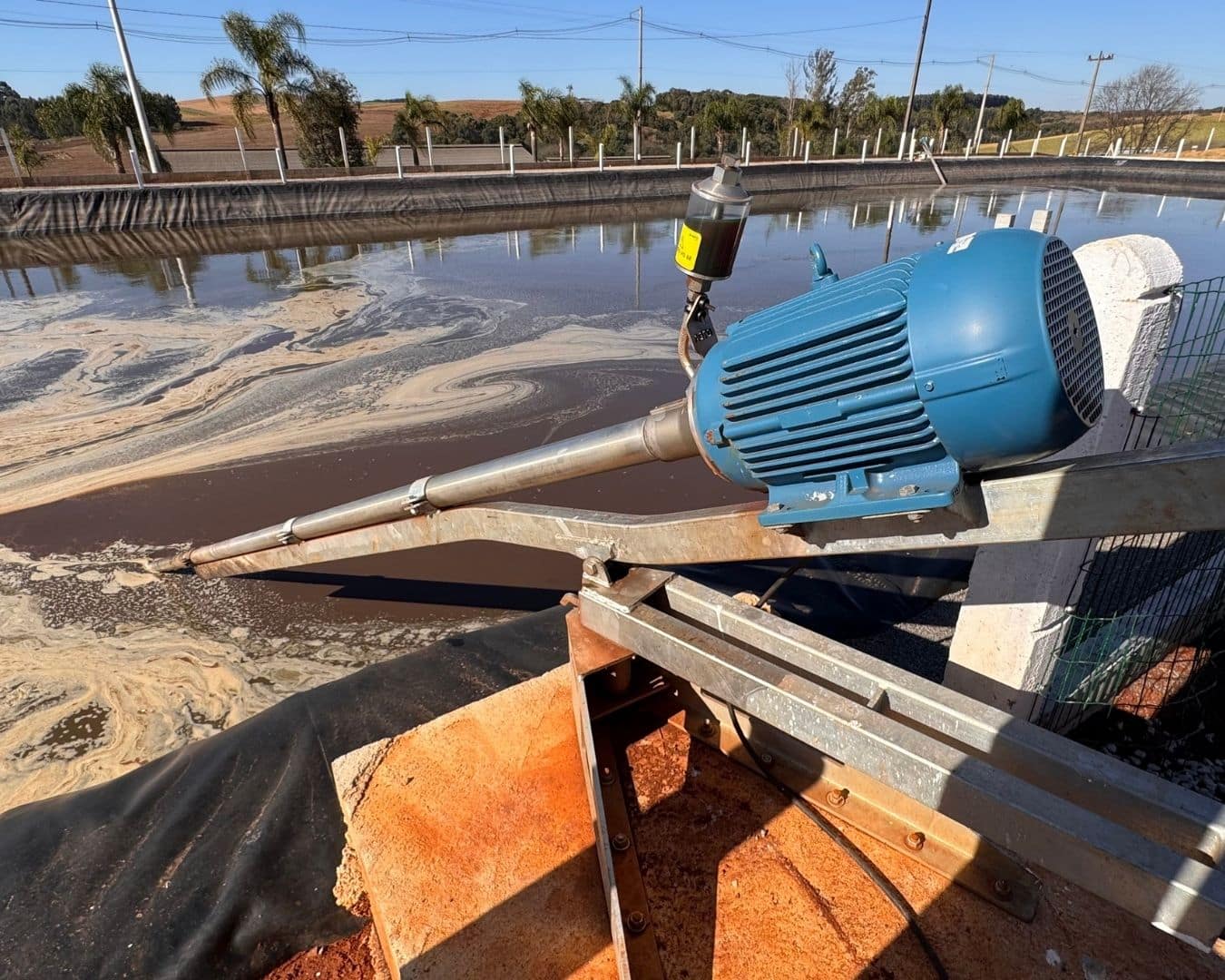
Agitator for handling waste.
The agitator ensures the homogenization of the waste, preventing the accumulation of solids and variations in the composition of the material.
This allows:
- Full use of the lagoon's volume.
- More uniform application to the soil.
- Lower risk of overflow.
- More environmental control
A homogeneous system facilitates compliance with legal requirements.
Solids separator in environmental management
The solids separator reduces the volume of material stored in the lagoon and improves the environmental management of the property.
With the separation:
- The solid fraction can be reused as organic fertilizer.
- The liquid fraction becomes more suitable for fertigation.
- The risk of contamination is reduced.
- It facilitates compliance with environmental regulations.
Furthermore, separating solids improves system organization and reduces environmental liabilities.
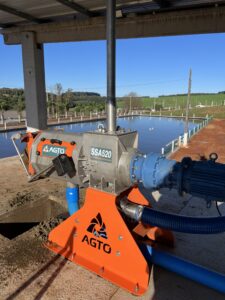
Inspection and risks for those who do not comply.
Environmental agencies have been expanding the use of:
- Scheduled and surprise technical inspections
- Satellite and drone monitoring
- Complaints and data cross-referencing
- Water quality analyses on neighboring properties
Penalties may include:
- Environmental fines (R$ 5,000 to R$ 50,000,000 depending on the severity)
- Suspension of activity
- Requirement for urgent adjustments with a specific deadline.
- Loss of licenses
- Civil and criminal liability in serious cases
Investing in proper management and technology is, therefore, a form of legal and operational protection.
Environmental compliance as a competitive advantage
More than just avoiding problems, complying with environmental legislation strengthens the property's image.
Compliant producers:
- They have an easier time with licensing and renewals.
- They reduce the risk of future fines.
- They meet the requirements of certification and traceability programs.
- They demonstrate professionalism and social and environmental responsibility.
- They add value to the final product.
Environmental management is no longer a cost but has become part of the strategy of the modern farm.
AGTO: technology for legal waste management
AGTO develops solutions designed to help rural producers operate efficiently and in compliance with environmental requirements.
With properly sized agitators and separators, the property benefits from:
- More control over management.
- Reducing environmental risks
- Compliance with legislation
- Security for sustainable growth.
- Technical documentation to be submitted to regulatory bodies.
Each project is evaluated technically, taking into account legal requirements and the reality of the farm.
Conclusion
Environmental legislation regarding waste management is clear: producers must control, store, and properly dispose of the waste generated. Ignoring these requirements creates risks that can compromise the entire operation.
With planning, appropriate technology, and technical support, it is possible to comply with legislation, reduce environmental impacts, and make management more efficient.